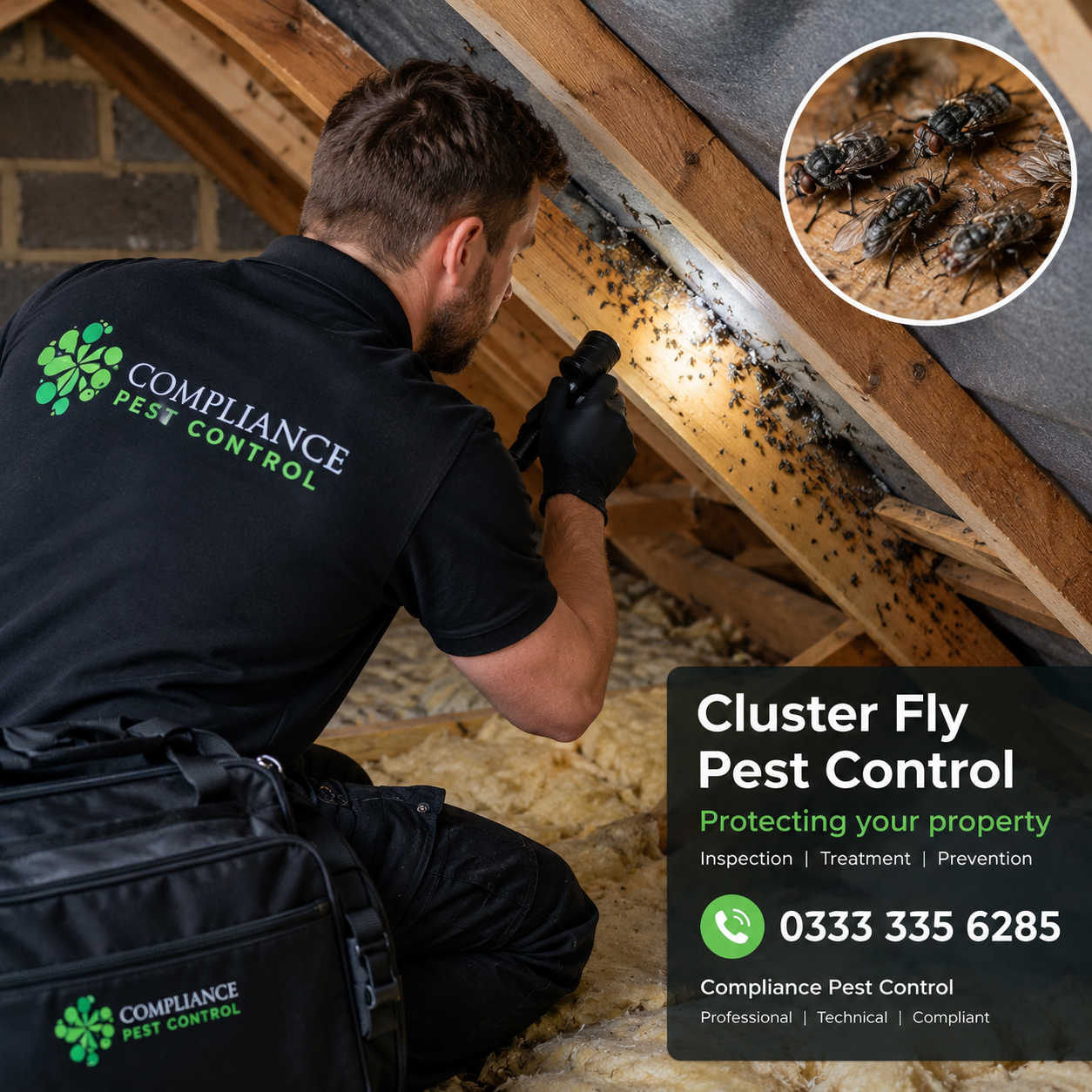

A practical guide for food manufacturers and food businesses
For food manufacturers and businesses operating within the food industry, pest management is an essential part of maintaining food safety, protecting products and demonstrating due diligence.
During a BRCGS or SALSA audit, pest control arrangements may come under close scrutiny. It is not enough to demonstrate that a pest control contractor visits the premises regularly. Businesses must also be able to show that their pest management programme is effective, properly documented, risk-based and subject to ongoing review.
At Compliance Pest Control Ltd, we work with commercial and food-sector businesses to support effective pest prevention, monitoring and compliance through professional pest management and technical inspections.
So, what should businesses expect an auditor to look for?
1. A documented pest management programme
Auditors will expect to see evidence that a suitable pest management programme is in place and that it reflects the risks associated with the premises and its activities.
This should include:
- A clearly defined pest management service.
- Identification of the pests relevant to the site.
- Appropriate inspection and monitoring arrangements.
- Defined responsibilities between the business and its pest control contractor.
- A documented approach to dealing with pest activity and recommendations.
The programme should be appropriate to the type of business, building layout, surrounding environment and products being handled.
A standard monitoring programme may not be suitable for every site. Pest management arrangements should be reviewed when operations, building structures or site risks change.
2. An up-to-date pest control site plan
One of the key documents auditors may request is the pest control site plan.
This should clearly identify the location and reference number of pest monitoring and control devices throughout the premises.
The plan should accurately reflect the devices installed on site, including relevant external and internal monitoring points.
Auditors may compare the plan against the actual devices during their site inspection. Missing, incorrectly positioned or unrecorded devices can raise questions about the effectiveness of the monitoring programme.
It is therefore important that site plans are updated whenever monitoring arrangements change.
3. Pest control inspection reports and service records
Pest management records should provide a clear history of inspections, findings and actions taken.
Auditors may review:
- Dates of pest control visits.
- Inspection findings and recorded pest activity.
- Monitoring device condition and results.
- Treatments or control measures undertaken.
- Recommendations made by the pest control contractor.
- Corrective actions and evidence of completion.
Records should be clear, accurate and accessible.
Importantly, recommendations should not simply be recorded and forgotten. Where a pest control contractor identifies a building defect, housekeeping issue or potential entry point, the business should demonstrate that the matter has been investigated and addressed appropriately.
4. Evidence of pest activity and trend analysis
An effective pest management programme should do more than record individual inspection results.
Businesses should be able to demonstrate that pest activity is reviewed over time to identify recurring problems, changes in activity and areas requiring further attention.
For example, repeated rodent activity around a loading bay could indicate a potential access issue, while recurring insect activity in a particular production or storage area may suggest an underlying environmental or structural risk.
Trend analysis can help identify:
- Repeated activity at particular monitoring points.
- Seasonal changes in pest activity.
- Potential building defects or access routes.
- Areas where housekeeping improvements may be required.
- Whether previous corrective actions have been effective.
This information should be used to improve the pest management programme rather than simply being retained as historical records.
5. Pest proofing and building maintenance
Pest proofing is an important part of preventing pest access to food premises.
During an audit, the condition of the building and the effectiveness of pest prevention measures may be considered.
Potential issues include:
- Gaps beneath external doors.
- Damaged air bricks and ventilation openings.
- Unsealed service penetrations.
- Damaged wall panels or cladding.
- Gaps around loading doors.
- Damaged insect screens.
- Unprotected roof spaces and other potential access points.
Where defects are identified, businesses should have a system for recording recommendations, assigning responsibility and completing remedial work.
Effective pest management requires cooperation between the pest control contractor, site management and maintenance teams.
6. Flying insect control equipment
Flying insect management is particularly important in food manufacturing, preparation and storage environments.
Auditors may consider whether insect monitoring or control equipment is appropriately positioned, operational and maintained.
This may include checking:
- Whether units are positioned appropriately for the area.
- Whether equipment is functioning correctly.
- Whether replacement lamps are within their recommended service life.
- Whether glue boards or other monitoring components are suitable and maintained.
- Whether equipment presents a potential contamination risk.
Insect control equipment should be selected and positioned with the layout and activities of the premises in mind.
For example, the location and design of an insect-killing unit should be considered carefully where exposed food, ingredients or packaging could be affected by expelled insect fragments.
7. Staff awareness and reporting procedures
Employees play an important role in identifying and reporting pest activity.
A well-managed pest control programme should include arrangements for staff to report sightings, droppings, damaged packaging or other signs of pest activity.
Auditors may ask employees how they would report a pest sighting and who is responsible for dealing with the issue.
Staff should understand that suspected pest activity must be reported promptly rather than ignored or dealt with informally.
Appropriate pest awareness training can help ensure that employees understand the importance of reporting potential problems and maintaining good housekeeping standards.
8. An annual in-depth pest management assessment
Routine pest control visits provide ongoing monitoring, but they should not replace a wider review of the pest management arrangements.
For sites certified to BRCGS Food Safety Issue 9, clause 4.14.10 requires an in-depth, documented pest management assessment by a pest management expert at a frequency based on risk, but at least annually.
This assessment should consider the site, equipment and facilities, review existing pest management measures and identify recommendations for improvement.
A thorough assessment can help identify weaknesses that may not be apparent during routine monitoring visits.
It also provides an opportunity to review whether the existing programme remains suitable for the current operation.
How Compliance Pest Control Ltd can support your business
At Compliance Pest Control Ltd, we understand that commercial pest management involves much more than routine pest control visits.
Our approach combines preventative monitoring, technical inspections, practical recommendations and ongoing support to help businesses maintain effective pest management arrangements.
We provide services including:
- Commercial and industrial pest management.
- Food manufacturing pest control programmes.
- Rodent and insect monitoring.
- Flying insect control.
- Pest proofing inspections and recommendations.
- Technical pest management assessments.
- Pest trend analysis and reporting.
- Pest awareness training.
- Support with BRCGS, SALSA and other food-sector audit requirements.
Our technical expertise helps businesses understand their pest risks, identify potential weaknesses and maintain a structured approach to pest prevention.
Preparing for your next food safety audit?
Do not wait until an audit is approaching to review your pest management arrangements.
Regularly checking your documentation, monitoring equipment, site plan, recommendations and corrective actions can help identify potential gaps before they become a problem.
Whether you are preparing for a BRCGS, SALSA or customer audit, Compliance Pest Control Ltd can help you review your existing arrangements and identify opportunities for improvement.
Professional Pest Management. Technical Expertise. Complete Compliance.
Contact Compliance Pest Control Ltd
Telephone: 0333 335 6285
Email: info@compliancepestcontrol.com
Website: www.compliancepestcontrol.com
Speak to our team about commercial pest management, technical inspections and audit support across Wales and the South West of England.